A plank is timber that is flat, elongated, and rectangular with parallel faces that are higher and longer than wide. Used primarily in carpentry, planks are critical in the construction of ships, houses, bridges, and many other structures.[1] Planks also serve as supports to form shelves and tables.
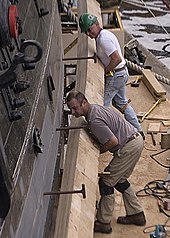
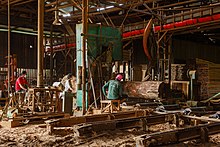
Usually made from sawed timber, planks are usually more than 11⁄2 in (38 mm) thick, and are generally wider than 21⁄2 in (64 mm). In the United States, planks can be any length and are generally a minimum of 2 in (51 mm) deep by 8 in (200 mm) wide, but planks that are 2 in (51 mm) by 10 in (250 mm) and 2 in (51 mm) by 12 in (300 mm) are more commonly stocked by lumber retailers. Planks are often used as a work surface on elevated scaffolding, and need to be wide enough to provide strength without breaking when walked on. The wood is categorized as a board if its width is less than 21⁄2 in (64 mm), and its thickness is less than 11⁄2 in (38 mm).
A plank used in a building as a horizontal supporting member that runs between foundations, walls, or beams to support a ceiling or floor is called a joist.
The plank was the basis of maritime transport: wood floats on water, and abundant forests meant wooden logs could be easily obtained and processed, making planks the primary material in ship building. However, since the 20th century, wood has largely been supplanted in ship construction by iron and steel, to decrease cost and improve durability.[2]
Gallery




| This article uses material from the Wikipedia article Metasyntactic variable, which is released under the Creative Commons Attribution-ShareAlike 3.0 Unported License. |