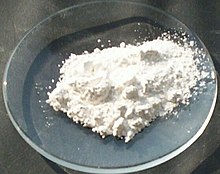
Calcium hydroxide (traditionally called slaked lime) is an inorganic compound with the chemical formula Ca(OH)2. It is a colorless crystal or white powder and is produced when quicklime (calcium oxide) is mixed or slaked with water. It has many names including hydrated lime, caustic lime, builders' lime, slack lime, cal, and pickling lime. Calcium hydroxide is used in many applications, including food preparation, where it has been identified as E number E526. Limewater is the common name for a saturated solution of calcium hydroxide.


 ?)
?)Properties
Calcium hydroxide is relatively insoluble in water, with a solubility product Ksp of 5.5 × 10⁻⁶. Its acid dissociation constant, Ka, is large enough that its solutions are basic according to the following reaction:
- Ca(OH)2 → Ca2+ + 2 OH−
At ambient temperature, calcium hydroxide (portlandite) dissolves in pure water to produce an alkaline solution with a pH of about 12.4. Calcium hydroxide solutions can cause chemical burns. At high pH value (see common ion effect), its solubility drastically decreases. This behavior is relevant to cement pastes. Aqueous solutions of calcium hydroxide are called limewater and are medium strength bases that reacts with acids and can attack some metals such as aluminium (amphoteric hydroxide dissolving at high pH) while protecting other metals from corrosion such as iron and steel by passivation of their surface. Limewater turns milky in the presence of carbon dioxide due to formation of calcium carbonate, a process called carbonatation:for example lime water
- Ca(OH)2 + CO2 → CaCO3 + H2O
When heated to 512 °C, the partial pressure of water in equilibrium with calcium hydroxide reaches 101 kPa (normal atmospheric pressure), which decomposes calcium hydroxide into calcium oxide and water.[7]
- Ca(OH)2 → CaO + H2O
Structure, preparation, occurrence

Calcium hydroxide adopts a polymeric structure, as do all metal hydroxides. The structure is identical to that of Mg(OH)2 (brucite structure); i.e., the cadmium iodide motif. Strong hydrogen bonds exist between the layers.[8]
Calcium hydroxide is produced commercially by treating lime with water:
- CaO + H2O → Ca(OH)2
In the laboratory it can be prepared by mixing aqueous solutions of calcium chloride and sodium hydroxide. The mineral form, portlandite, is relatively rare but can be found in some volcanic, plutonic, and metamorphic rocks. It has also been known to arise in burning coal dumps.
The positively charged ionized species CaOH+ has been detected in the atmosphere of S-type stars.[9]
Retrograde solubility
The solubility of calcium hydroxide at 70 °C is about half of its value at 25 °C. The reason for this rather uncommon phenomenon is that the dissolution of calcium hydroxide in water is an exothermic process, and also adheres to Le Chatelier's principle. A lowering of temperature thus favours the elimination of the heat liberated through the process of dissolution and increases the equilibrium constant of dissolution of Ca(OH)2, and so increase its solubility at low temperature. This counter-intuitive temperature dependence of the solubility is referred to as "retrograde" or "inverse" solubility. The variably hydrated phases of calcium sulfate (gypsum, bassanite and anhydrite) also exhibit a retrograde solubility for the same reason because their dissolution reactions are exothermic.
Uses
Calcium hydroxide is commonly used to prepare Lime mortar.
One significant application of calcium hydroxide is as a flocculant, in water and sewage treatment. It forms a fluffy charged solid that aids in the removal of smaller particles from water, resulting in a clearer product. This application is enabled by the low cost and low toxicity of calcium hydroxide. It is also used in fresh water treatment for raising the pH of the water so that pipes will not corrode where the base water is acidic, because it is self-regulating and does not raise the pH too much.
It is also used in the preparation of ammonia gas (NH3), using the following reaction:
- Ca(OH)2 + 2NH4Cl → 2NH3 + CaCl2 + 2H2O
Another large application is in the paper industry, where it is an intermediate in the reaction in the production of sodium hydroxide. This conversion is part of the causticizing step in the Kraft process for making pulp.[8] In the causticizing operation, burned lime is added to green liquor, which is a solution primarily of sodium carbonate and sodium sulfate produced by dissolving smelt, which is the molten form of these chemicals from the recovery furnace.
Food industry
Because of its low toxicity and the mildness of its basic properties, slaked lime is widely used in the food industry:
- In USDA certified food production in plants and livestock[10]
- To clarify raw juice from sugarcane or sugar beets in the sugar industry, (see carbonatation)
- To process water for alcoholic beverages and soft drinks
- Pickle cucumbers and other foods
- To make Chinese century eggs
- In maize preparation: removes the cellulose hull of maize kernels (see nixtamalization)
- To clear a brine of carbonates of calcium and magnesium in the manufacture of salt for food and pharmaceutical uses
- In fortifying (Ca supplement) fruit drinks, such as orange juice, and infant formula
- As a digestive aid (called Choona, used in India in paan, a mixture of areca nuts, calcium hydroxide and a variety of seeds wrapped in betel leaves)
- As a substitute for baking soda in making papadam
- In the removal of carbon dioxide from controlled atmosphere produce storage rooms
Native American uses

In Spanish, calcium hydroxide is called cal. Maize cooked with cal (in a process of nixtamalization) becomes hominy (nixtamal), which significantly increases the bioavailability of niacin (vitamin B3), and is also considered tastier and easier to digest.
In chewing coca leaves, calcium hydroxide is usually chewed alongside to keep the alkaloid stimulants chemically available for absorption by the body. Similarly, Native Americans traditionally chewed tobacco leaves with calcium hydroxide derived from burnt mollusc shells to enhance the effects. It has also been used by some indigenous American tribes as an ingredient in yopo, a psychedelic snuff prepared from the beans of some Anadenanthera species.[11]
Asian uses
Calcium hydroxide is typically added to a bundle of areca nut and betel leaf called 'paan' to keep the alkaloid stimulants chemically available to enter the bloodstream via sublingual absorption.
It is used in making naswar (also known as nass or niswar), a type of dipping tobacco made from fresh tobacco leaves, calcium hydroxide (chuna or soon), and wood ash. It is consumed most in the Pathan diaspora, Afghanistan, Pakistan, India and Bangladesh. Villagers also use calcium hydroxide to paint their mud houses in Afghanistan, Pakistan and India.
Health risks
Unprotected exposure to Ca(OH)2 can cause severe skin irritation, chemical burns, blindness, lung damage or rashes. [5]
See also
- Baralyme (carbon dioxide absorbent)
- Cement
- Lime mortar
- Lime plaster
- Plaster
- Magnesium hydroxide (less alkaline due to a lower solubility product)
- Soda lime (carbon dioxide absorbent)
- Whitewash
| This article uses material from the Wikipedia article Metasyntactic variable, which is released under the Creative Commons Attribution-ShareAlike 3.0 Unported License. |